All content and media files are published under a Creative Commons Attribution-ShareAlike 4.0 International License (CC BY-SA 4.0)

Three main squares of the Upper Town (Grand, Lesser and Huet)
Sibiu and surrounding
Squares, Parks, Gardens
Address: Piata Mare
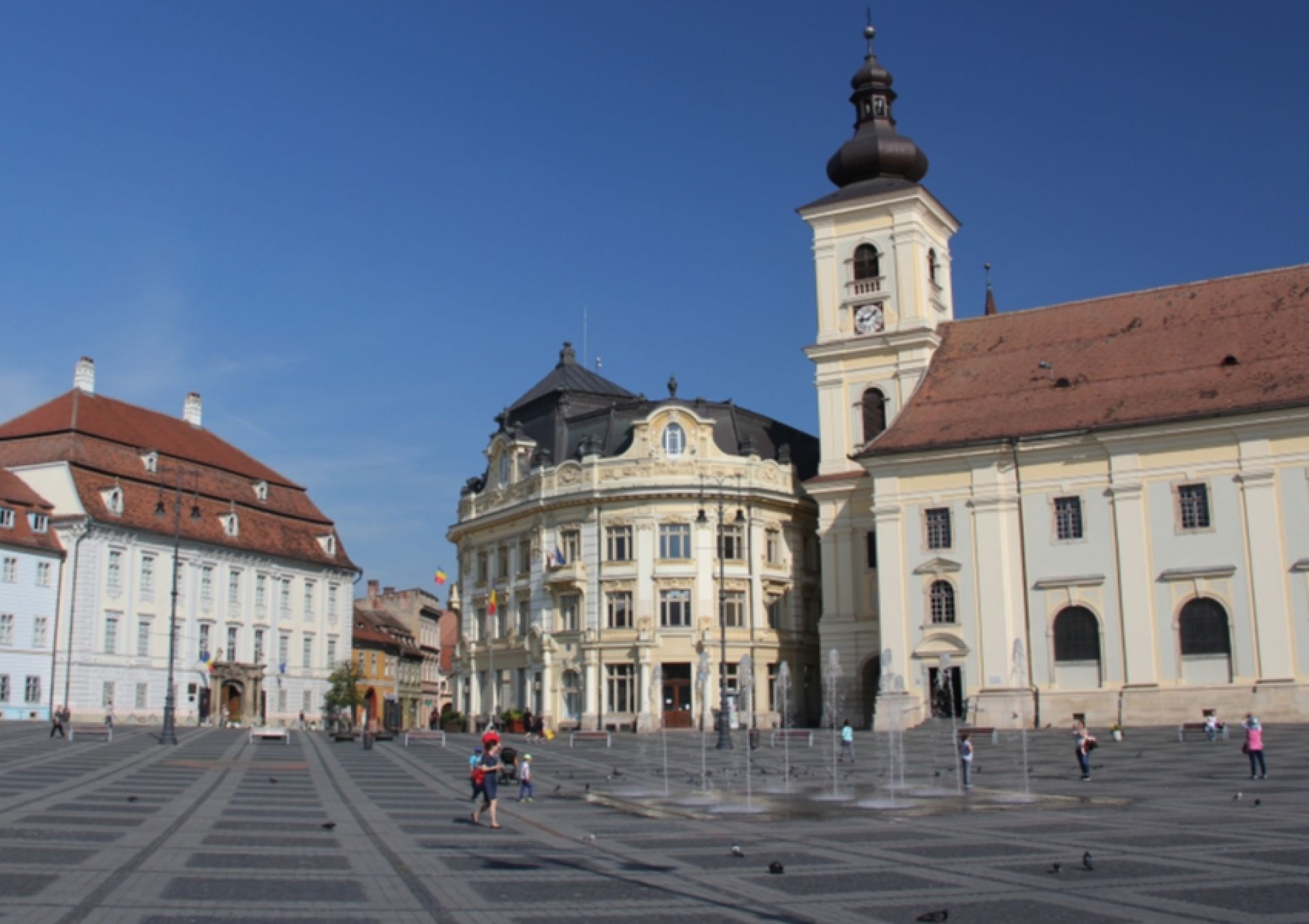
Sibiu is divided into the Upper Town and the Lower one. The main attractions of the Upper Town are centered around three squares: the "Grand Square", the "Lesser Square" and Huet Square. Any of the European capitals would envy the Baroque ensembles of these squares. But it is the cultural capital of Romania that is lucky enough to boast them. These three squares are interconnected. From the "Grand Square" to the "Lesser Square", you can go through the arch in the bell tower, and from the "Lesser Square" to Huet Square, you can get by crossing the Bridge of Lies. The two vertical dominants of the "Grand Square" (Piața Mare) are the Council Tower and the bell tower. Located next to the City Hall, the Council Tower houses the main city clock, 7 internal floors, and an observation deck from which one can see three squares at once. The bell tower belongs to the 14th-century church. Several houses deserve special attention, for example, the Brukenthal National Museum. After the Bucharest Art Museum, it is the largest collection of works of art in Romania. For example, it displays the painting "Winter Landscape with Ice skaters and Bird trap" by Pieter Bruegel the Elder.
The museum is adjacent to the Blue House. In its large courtyard, as in the courtyard of the museum, you can hide from the sun among the trees and flowering rose bushes. You can also freshen up on the square itself: there are "hidden" fountains that suddenly turn on, showering onlookers.
All the houses on the square have "names": the asymmetrical house of Hecht (Casa Hecht), the house of Lutsch, the house of Haller. In the heart of the city, there is a large supermarket hidden behind the trees. The small square has an unusual crescent shape and was first mentioned in the annals of 1370. Besides, it houses one of the city symbols, the Arts House (Casa Artelor) with the Museum of Saxon Ethnography (the city was built by emigrated Germans) in it.
Seven fortress cities built by the Saxons were called "Siebenbürgen" and pursued a policy of independence, from the Ottoman Empire for example.
Due to its name, the Bridge of Lies is associated with many legends. For example, it is believed that it will fall apart if a liar steps on it. However, it has stood still since about the middle of the 19th century.
Huet Square is the oldest in the city (1191) and bears the name of the member of the City Hall, who founded the city library on this square in the 16th century.
